
SPOTLIGHT
Managing Authenticity: The Paradox of Great Leadership
In this article, the authors explore the qualities of authentic leadership. To illustrate their points, they recount the experiences of some of the authentic leaders they have known and studied, including the BBC’s Greg Dyke, Nestlé’s Peter Brabeck-Letmathe, and Marks & Spencer’s Jean Tomlin.
page 047
Harnessing the Science of Persuasion
If leadership, at its most basic, consists of getting things done through others, then persuasion is one of the leader’s essential tools. Many executives have assumed that this tool is beyond their grasp, available only to the charismatic and the eloquent. Over the past several decades, though, experimental psychologists have learned which methods reliably lead people to concede, comply, or change. Their research shows that persuasion is governed by several principles that can be taught and applied.
The first principle is that people are more likely to follow someone who is similar to them than someone who is not. Wise managers, then, enlist peers to help make their cases. Second, people are more willing to cooperate with those who are not only like them but who like them, as well. So it’s worth the time to uncover real similarities and offer genuine praise.
Third, experiments confirm the intuitive truth that people tend to treat you the way you treat them. It’s sound policy to do a favor before seeking one. Fourth, individuals are more likely to keep promises they make voluntarily and explicitly. The message for managers here is to get commitments in writing. Fifth, studies show that people really do defer to experts. So before they attempt to exert influence, executives should take pains to establish their own expertise and not assume that it’s self-evident. Finally, people want more of a commodity when it’s scarce; it follows, then, that exclusive information is more persuasive than widely available data.
By mastering these principles—and, the author stresses, using them judiciously and ethically—executives can learn the elusive art of capturing an audience, swaying the undecided, and converting the opposition.
HBR Reprint 7915
FEATURES
finance
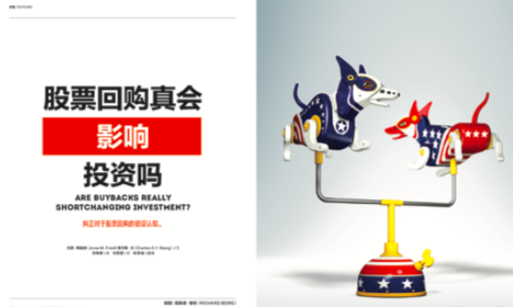
Are Buybacks Really Shortchanging Investment?
Jesse M. Fried and Charles C.Y. Wang page 076
Some experts argue that corporate leaders are starving their firms of investment capital by making excessive payouts to shareholders, thereby undermining innovation, employment opportunity, and economic growth. As evidence, they point to S&P 500 firms’ using 96% of their net income for repurchases and dividends.
A closer look at the data shows that the amounts going to shareholders at the expense of internal investment are less than claimed. The problem lies in the ratio used—shareholder payouts as a percentage of net income—which fails to take into account offsetting equity issuances as well as actual R&D expenditures.
The percentage of income potentially available for investment that goes to shareholders is not 96% but a much more modest 41%. After paying shareholders, S&P 500 firms are at near-peak levels of investment and have huge stockpiles of cash for exploiting future opportunities.
There may well be severe corporate governance problems in the S&P 500, but the data suggests that excessive shareholder payouts is not one of them.
HBR Reprint R1802F

FEATURES
economy
Is Lack of Competition Strangling the U.S. Economy?
David Wessel | page 084
There’s no question that most American industries have become more concentrated. Economists are trying to understand whether this is necessarily a bad thing for competition.
The short answer: It’s complicated. Innovation superstars like Google have created winner-take-most markets largely by exploiting network effects, not through predatory behavior. However, research from the wider economy (including the tech sector) uncovers classic signs of unhealthy concentration: rising profits, weak investment, and low business dynamism.
The government’s approach to antitrust violations is due for an overhaul. And regulators need to pay more attention to protecting economic vitality and consumer
well-being—and less to industry lobbyists.
HBR Reprint R1802H

FEATURES
MARKETING
How Right Should the Customer Be?
Erin Anderson and Vincent Onyemah page 110
If your salespeople aren’t sure who their boss is—the district manager? the regional manager? the customer?—it could be a sign that your company’s sales force controls are working at cross-purposes and that your sales function is in trouble.
Sales force controls are the policies and practices that govern the way you train, supervise, motivate, and evaluate your sales staff. They include the types of compensation you offer your people and the criteria your sales managers use to evaluate the reps’ performance. These controls let salespeople know which trade-offs the company would prefer them to make when the inevitable conflicts arise between what they want to do (spend lots of time and money to get a sale) and what they actually can do (use limited resources and still get the sale).
When sales force controls aren’t aligned—when, say, the system simultaneously encourages reps to be entrepreneurial but also to file detailed call reports and check in frequently with their bosses—individuals become discouraged and unproductive, and they eventually leave the company. The authors’ research suggests there are significant differences between the control systems of companies that encourage salespeople to put the customer first—outcome control (OC) systems—and those that encourage reps to put their managers first—behavior control (BC) systems. In this article, they list the characteristics of OC and BC systems, describe the potential fallout from conflicts within these systems, and explain how you can tell which control system is appropriate for your firm. In most cases, the right choice will be a consistent system somewhere in the middle of the OC-BC continuum.
HBR Reprint 1001J