SPOTLIGHT
leadingculture
This package provides an essential guide todetermining your organization阵 current culture andshaping
it to fit your strategy.
page 051
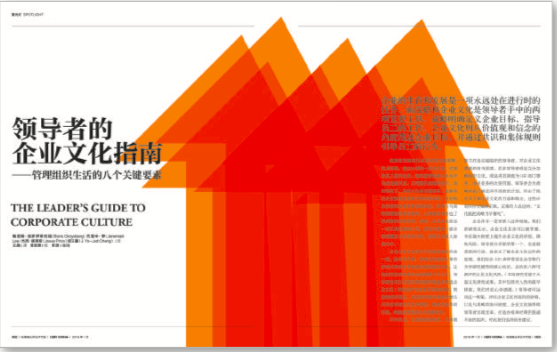
TheLeader’s Guide to Corporate Culture
Executives are often confounded by culture,because much of it is anchored in unspoken behaviors, mindsets, and socialpatterns. Many leaders either let it go unmanaged or relegate it to HR, whereit becomes a secondary concern for the business. This is a mistake, becauseproperly managed, culture can help them achieve change and build organizationsthat will thrive in even the most trying times.
The authors have reviewed the literature onculture and distilled eight distinct culture styles: caring, focused onrelationships and mutual trust; purpose, exemplified by idealism and altruism;learning, characterized by exploration, expansiveness, and creativity;enjoyment, expressed through fun and excitement; results, characterized byachievement and winning; authority, defined by strength, decisiveness, andboldness; safety, defined by planning, caution, and preparedness; and order,focused on respect, structure, and shared norms.
These eight styles fit into an “integratedculture framework” according to the degree to which they reflect independenceor interdependence (people interactions) and flexibility or stability (response
to change). They can be used to diagnoseand describe highly complex and diverse behavioral patterns in a culture and tomodel how likely an individual leader is to align with and shape that culture.
Through research and practical experience,the authors have arrived at five insights regarding culture’s effect oncompanies’ success: (1) When aligned with strategy and leadership, a strong culturedrives positive organizational outcomes. (2) Selecting or developing leadersfor the future requires a forward-looking strategy and culture. (3) In amerger, designing a new culture on the basis of complementary strengths canspeed up integration and create more value over time. (4) In a dynamic,uncertain environment, in which organizations must be more agile, learninggains importance. (5) A strong culture can be a significant liability when itis misaligned with strategy.
HBR Reprint R1801B
MANAGINGYOURSELF
TheBest Leaders Are Great Teachers
Sydney Finkelstein | page 135
What sets exceptional business leadersapart? One thing, says Sydney Finkelstein, is their ongoing commitment togiving direct reports one-on-one instruction. Finkelstein, a managementprofessor at Dartmouth’s Tuck School of Business, has studied world-classleaders for more than a decade. He’s found that they make a point of personallyimparting memorable lessons that fall into three categories: pointers onprofessionalism, technical knowledge and skills, and broader life lessons.
Finkelstein notes that when and where topleaders teach is almost as important as what they teach. Instead
of waiting for formal reviews, greatmanagers stay accessible to their employees and share their wisdom as opportunemoments arise, whether that’s in the office or outside it. They also createteaching moments—often by taking protégés off-site.
How do they make lessons stick? Theirtechniques include (1) customizing instruction to the needs, personality, anddevelopment path of each individual, (2) asking pertinent questions to deepenlearning, and (3) modeling the behavior they want others to practice.Finkelstein discusses numerous superstar leaders who are revered as greatteachers and suggests that if you follow their example, you can strengthen yourstaff and drive superior business performance.
HBR Reprint R1801M
FEATURES
Marketing
Adsthat don’t overstep
Leslie K. John, Tami Kim, and Kate Baraszpage 092
Data gathered on the web has vastlyenhanced the capabilities of marketers. With people regularly sharing personaldetails online and internet cookies tracking every click, companies can nowgain unprecedented insight into individual consumers and target them withtailored ads. But when this practice feels invasive to people, it can prompt astrong backlash. Marketers today need to understand where to the draw the line.
The good news is that psychologists alreadyknow a lot about what triggers privacy concerns off-line. These norms—and theauthors’ research—strongly suggest that firms steer clear of two ad-targetingtechniques generally disliked by consumers: using information obtained on athird-party site rather than on the site on which an ad appears, which is akinto talking behind someone’s back; and deducing information about people (suchas a pregnancy) from analytics when they haven’t declared it themselves.
If marketers avoid those tactics, use datajudiciously, focus on increasing trust and transparency, and offer peoplecontrol over their personal data, their ads are much more likely to be acceptedby consumers and help raise interest in engaging with a company and itsproducts.
HBR Reprint R1801C
FEATURES
ManagingPeople
CanMOOCs Solve Your Training Problem?
Monika Hamori | page 082
Companies say they want their employees tolearn and grow, but in practice, they skimp on training. In a recent study of1,481 employed learners, more than one-third of them said they had received notraining from their companies in the previous 12 months. Instead, many acquirework-related skills through MOOCs (massive open online courses)—usually withouttheir employers’ knowledge or support. This represents a missed opportunity forcompanies to harness their employees’ efforts in the service of organizationalgoals.
Managers can help team members put theirlearning into context by providing study time and informal guidance before andduring the courses. Having employees pilot courses for one another helps ensurerelevance and quality. And tracking completion reinforces the value of learningwhile increasing the odds that people will stick with their coursework.
HBR Reprint R1801D