英文摘要EXECUTIVE SUMMARIES MARCH 2017
SPOTLIGHT
The new Science of Team Chemistry
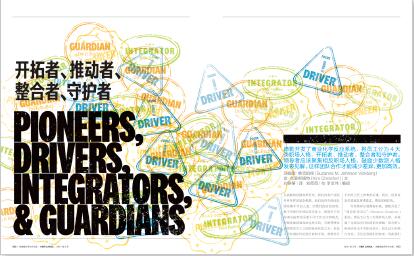
In this package we look at the personalitytypes that make up a team—and how to get the best from any combination.
page 050
Making the Most of Cognitive Diversity
When teams fall short of their potential,it’s often because leaders don’t know how to spot and manage the differences inhow people approach their work—and as a result, some of the best ideas gounheard
or unrealized. To help organizations claimthis lost value, Deloitte’s Suzanne M. Johnson Vickberg and Kim Christfortprovide a framework for identifying and managing four primary working styles.
Pioneers value possibilities, and theyspark energy and imagination on their teams. Guardians value stability, andthey bring order and rigor. Drivers value challenge and generate momentum. AndIntegrators value connection and draw teams together. Every person is acomposite of these four styles, though most people’s behavior and thinking areclosely aligned with one or two.
The four styles give leaders and theirteams a common language for discussing similarities and differences in howpeople experience things and prefer to work.
Once managers have identified the workstyles of their team members and considered how the differences among them arebeneficial or problematic, they must take steps to ensure that they’re not leftwith all frustration and no upside.
To get the most from the styles on theirteams, leaders should (1) pull opposite types closer together to generateproductive friction, (2) give more visibility and voice to people withnondominant perspectives, and (3) take extra care to get input from sensitiveintroverts, who risk being drowned out but have valuable contributions to make.
Five Executives Weigh In
Senior leaders at Marriott, AmericanExpress, Southwest, National Grid, and Kellogg share their experiences inapplying Deloitte’s framework in their teams and organizations.
A Biological Approach
Helen Fisher, the biological anthropologistwhose research informed Deloitte’s work on team chemistry, derives herpersonality assessment from brain science. In searching for an answer to whatmakes an individual fall in love with one person and not another, she foundthat four biological systems—dopamine/norepinephrine, serotonin, testosterone,and estrogen/oxytocin—are each linked to a particular suite of personalitytraits. Fisher explains the science behind her work, talks about how toidentify and adjust productively to others’ personality styles, and considerswhether personality screening can and should inform management decisions.
The Tests That Shaped the Industry
Over the past 100 years, three tests—theMyers-Briggs Type Indicator, the Five-Factor Model, and StrengthsFinder—havehad an outsize impact on the theory and practice of personality screening.
HBR Reprint R1702B
MANAGING YOURSELF

Surviving M&A
Mitchell Lee Marks, Philip Mirvis, and RonAshkenas | page 143
If your company is undergoing a merger oracquisition, you’re apt to feel anxious. Roughly 30% of employees are deemedredundant when firms in the same industry merge. But you needn’t dread theoutcome, say the authors, who draw on their experience as academics
and consultants. They’ve found thatemployees usually reap great rewards if they embrace the M&A process as a chance for introspection and growth.
Your first step should be to figure outwhere you stand. The authors recommend conducting a SWOT analysis: Assess yourstrengths and weaknesses and the opportunities and threats that the dealpresents. Then get involved in the integration effort—in a way that lets youshowcase or sharpen your skills. Executing transition plans, innovating, andcollaborating with new colleagues are all postmerger opportunities for personalgrowth. If you prove adept, you will be well positioned for success in the hybrid organization—or at anothercompany.
The authors suggest specific questions toask yourself as you take stock of the situation. They provide tips on how tomake sure you have a role in the integration work. And they present brief casestudies of four professionals who followed the recommended approach and emergedfrom their companies’ M&A deals as “winners.”
HBR Reprint R1702M
FEATURES

Strategy
Strategy in the Age of Superabundant Capital
Michael Mankins, Karen Harris, and DavidHarding | page 068
For much of the past five decades,financial capital was considered a scarce resource. Today, however, capital isabundant and cheap, and the authors expect that to be the case for another 20years or more. They point out that global financial assets have been growingfaster than global GDP, and they explain why that trend is likely to continue.They note, too, that as the supply of capital has increased, the cost hasplunged, making it possible for many large firms to borrow funds for next tonothing. What all this means is that companies can no longer sustaincompetitive advantage simply by allocating capital skillfully.
In this new climate, the authors argue,business leaders need to lower hurdle rates and change their investmentstrategy, moving away from a few big bets and instead pursuing numerous small,varied growth opportunities. Not all will pan out, but embracing the risk offailure is necessary for success.
Executives must also recognize that humancapital is the truly scarce resource today. Organizations need to manage theirworkforces as carefully and rigorously as they manage their financial assets,unleashing and supporting the talent within their organizations.
HBR Reprint R1702C
How I Did It

sustainability
tiffany’s ceo on creating a sustainablesupply chain
Frederic Cumenal | page 042
Vertical integration, a major competitiveadvantage at Tiffany, is entrenched for two reasons: a deeply held belief thatgreat houses of luxury should craft their own designs, and an equally strongconviction that diamond traceability is the best means of ensuring social andenvironmental responsibility.
Tiffany’s focus on sustainability beganabout 25 years ago, in the context of growing awareness about the toxicchemicals used in extracting precious metals and about “conflict diamonds” fromcountries at war. Since then the company has been an industry leader inaddressing environmental and human rights concerns. Its stones are laser-inscribed withmicroscopic codes indicating their provenance so that Tiffany can ensure itschain of diamond custody.
HBR Reprint R1702A